How a Nutritionist Actually Eats on Holiday (When the Healthy Options Aren’t Great)

Updated: Sep 27
I spend a lot of time talking to people about food.
How to build a balanced meal. How to make better choices when life is busy. How to work around food sensitivities. How to recognise when your body isn't coping particularly well with what you're giving it.
But I firmly believe all of that advice has to work in real life.
And real life sometimes looks like being away on a family holiday, without a kitchen or a car, spending your days at theme parks, paying resort prices for food, and discovering that most of your readily available lunch options involve some combination of chips, burgers, pizza, chicken nuggets and fried fish.
That was our recent family holiday to Sea World on the Gold Coast.
We had an absolutely wonderful holiday and loved our stay — but, like most holidays, eating away from home for a week meant working with very different options and circumstances than we normally would.
And while I certainly didn't go into the week expecting to eat exactly as I would at home, by the end of day two my body was already starting to give me some very familiar little whispers:
We're getting close to the limit here. You might want to do something about this.
So I did.
Not by putting myself on a strict diet.
Not by missing out on the holiday.
And definitely not by deciding that the cocktails, ice creams and buffet breakfasts had been a terrible mistake.
I simply went back to the same principles I teach my clients:
keep the foundations in place where you can
make the best choices available to you
enjoy the things that are worth the trade-off
listen when your body tells you the balance needs to shift.
Because healthy eating on holiday isn't about eating perfectly — there HAS to be space to relax and enjoy yourself.
It's about knowing how to look after yourself when perfect isn't even an option.

Want the Practical Version?
This article takes you through how these principles actually looked on our family holiday — the imperfect meals, limited options, things that worked, and the points where I needed to adjust.

If you're planning your own trip and would rather jump straight to the practical steps, I've put them into a free Eating Well on Holiday guide you can save to your phone or print before you go.
PROTEIN • PLANTS • ENJOY • ADJUST
Or keep reading to see how it all worked in real life.
Before We Left: I Kept Things Simple
I don't want to travel with half a dispensary of supplements — nor do I recommend this to my clients — so before we left I deliberately simplified.
Rather than trying to replicate everything we might use at home, I thought about our most likely support points while we were away.
I took one nutritional powder that covered several bases for the whole family — including some of the support I normally use when the kids complain of growing pains, but also useful after long days on our feet.
I packed digestive support, knowing we'd be eating unfamiliar restaurant and theme-park food and would almost certainly overdo it once or twice, and a broad nutritional supplement because my husband and I tend to do better with that extra support when we're busy, active and out of routine.
Three products. Multiple purposes. Less stuff to pack, take and remember.
And I think there's a bigger principle in that.
Over time, one of the things I hope people learn — whether through working with me or simply through becoming more familiar with their own body — is what they actually need.
You begin to recognise your usual weak points, your body's early whispers, what genuinely helps and what you don't need to throw at every situation "just in case".
That's very different from trying to cover every possible scenario with a suitcase full of supplements.
We also took some protein bars and beef jerky sticks for the plane and snacks while we were out and about.
That part turned out to be very useful.
What I didn't organise — and what I would absolutely do differently next time — was groceries delivered to the resort as soon as we arrived.
I had assumed we'd be able to find enough suitable food around us.
Technically, we could.
Practically, it wasn't quite that simple.
My Simplest Rule When You Don't Know What to Eat
There is a very simple principle I often give clients when they're eating somewhere unfamiliar and don't know what to choose:
Start with protein, then surround it with plants.
It doesn't have to be complicated.
Find your protein first. Then look for whatever plant foods are realistically available — vegetables, salad, fruit, legumes, nuts, seeds or something similar.
Protein acts as an anchor, helping make the meal more substantial and satisfying while supporting steadier energy, appetite and blood sugar.
Plants bring back some of the freshness, fibre, nutrients, colour and variety that can disappear quickly when you're relying on restaurant, takeaway and convenience food.
It's not a rule for creating a nutritionally perfect plate.
It's a way of finding your bearings when your normal choices aren't available.
And on this holiday, I used it constantly.
The Breakfast Buffet Was Actually Our Best Opportunity
Breakfast was included at the resort, so this became the meal where I knew I could get a decent amount of food into everyone before we headed out for the day.
For myself, I started with protein.
That might have been eggs, sausage and bacon, then baked beans, cooked tomato, some fried rice and fruit. Some mornings there was a frittata with vegetables or other options I could add.
And yes, there was coffee (that occasionally came with a small pastry that looked too good to resist!).
Were the sausages and bacon necessarily the protein sources I'd choose to eat every morning at home? No.
Could there have been dairy in the scrambled eggs? Quite possibly.
Did I nutritionally need the pastry? Of course not.
But this is where I think we can make healthy eating unnecessarily difficult.
I wasn't standing in my own kitchen with access to every food I normally buy. I was standing at a resort breakfast buffet trying to feed myself before spending most of the day walking around a theme park.
So I chose the best combination available to me, made it reasonably balanced, enjoyed it and moved on with my day.
That's very different from giving up on healthy eating altogether because you can't do it perfectly.
And Then There Were the Kids...
Being the children of a nutritionist, my kids are very familiar with conversations about protein, vegetables and what their bodies need.
They absolutely get occasional treats at home, but a breakfast buffet containing Cocoa Pops, Nutri-Grain, juice, pancakes, pastries and even ice cream was understandably a whole new level of excitement.
I didn't want to spend our holiday standing over them saying no, and I genuinely wanted them to experience the joy of food on their holiday.
So we had a very simple arrangement:
Give your body what it needs first, and then go and enjoy the buffet.
They would start with some protein — usually eggs and perhaps a sausage — and we'd put a plate of fruit on the table to share.
Once they'd eaten some proper food, they were free to go back and choose what they wanted.
And they did.
There were sugary cereals. Pancakes. Juice. Pastries. Ice cream at breakfast.
And I was completely okay with that.
Not because those foods suddenly became nutritious because we were on holidays.
But because nutrition isn't the only thing food gives us.
Food is also celebration, culture, pleasure, excitement, connection and memory.
Part of teaching children to eat well, in my view, is teaching them how to nourish their bodies. Another part is allowing food to be joyful and recognising that sometimes the experience matters more than the nutritional quality of an individual meal.
I didn't need their breakfast to be perfect.
I wanted some nutritional foundations underneath it — and then I wanted them to be kids.
Lunch Was Where Things Became Much Harder
Once we were out at the theme parks, the choices became much more limited.
There were plenty of chips, burgers, chicken nuggets, fried fish and similar foods, but not a lot of fresh food that was convenient, affordable and substantial enough to feed a family.
This is where the protein bars and beef jerky sticks we had packed became very handy.
Some days lunch might genuinely have been a protein bar and some shared chips.
Was that my ideal lunch?
Of course not.
But again, you have to work with the situation you're actually in — not the imaginary situation where you're standing beside a perfectly stocked kitchen.
One day we headed towards a Mexican restaurant at one of the theme parks, quite excited because we thought we'd finally found somewhere we could get something a little more substantial.
Then we saw the prices.
By that point we were tired, hungry and a little overwhelmed by trying to work out what everybody was going to eat. My son said he wanted a hot dog and, frankly, that was enough to make the decision for us.
So we all had hot dogs.
Twelve-dollar hot dogs.
And they may genuinely have been the most disgusting hot dogs I've ever eaten.
I couldn't believe how much we'd just spent on them, they weren't even enjoyable, and mine left my stomach feeling uneasy for the remainder of the day.
But I think even that is part of the reality of eating away from home.
Sometimes you've carefully weighed up all the options. Sometimes everyone is hungry and tired, the prices are ridiculous, one person finally makes a decision and you think, Great. Hot dogs it is.
You eat it, learn from it and move on.
Not every less-than-ideal meal needs to become a nutritional crisis.
We were also walking around theme parks for hours, so by the time we got back to the resort everyone was hungry — not generally the moment when children or adults make their most considered nutritional decisions.
So there were afternoons involving chips. There was pizza. And then we'd still need to work out dinner.
The resort did have some fresher options. I had a poke bowl. There was a salad with choice of protein I could order. We went to the buffet one evening, and I was ridiculously excited to see a large selection of vegetables.
But you can only eat the same poke bowl or salad so many times, and feeding a family at resort buffet prices every night becomes very expensive very quickly.
By the end of our second day, I realised we needed another option.
Sometimes You Have to Get Creative

Once we'd been there a couple of days, I realised I needed to widen the search beyond whatever happened to be available at the resort.
We didn't have a car to drive to a supermarket or restaurant, but we did have Uber Eats.
One night I found an Indian restaurant where I could order meat, vegetables and rice. Another night we found noodles with meat and plenty of vegetables.
There was just one small logistical problem.
We still didn't have plates or proper cutlery.
So we requested wooden spoons with the order and got creative with the coffee cups in our hotel room.
Meat, vegetables and rice eaten out of a coffee cup with a wooden spoon might not have been the most elegant holiday meal, but it did the job.
And that's another thing I'd encourage you to remember when you're away:
What's immediately around you isn't necessarily all that's available to you.
If you're staying somewhere without a car, look at grocery delivery. Look at restaurant delivery. Search for the components you're actually missing rather than trying to find somewhere advertising itself as "healthy".
Sometimes a curry with meat, vegetables and rice or a noodle dish loaded with vegetables is exactly what you need.
And sometimes you eat it from a coffee cup.
This Is Where My Body's "Whispers" Became Useful
One of the concepts I teach is that everybody has a tolerance threshold.
Your body is constantly dealing with a total load.
Food is part of that load, but so are things like sleep, stress, hormones, illness, inflammation, digestion, physical exertion and simply having a lot going on at once.
When you're comfortably below your threshold, your body can often accommodate quite a lot of normal life.
A takeaway meal. A late night. A few foods you don't normally eat. A glass of wine. A dessert. A busy day.
The problem isn't necessarily any one of those things.
It's when the total load begins to accumulate.
On holiday, my usual routine had changed completely.
I was eating more processed and restaurant food than usual, fewer fresh vegetables, ingredients I wouldn't normally choose, some foods I don't tolerate particularly well, more treats, a few cocktails, different meal timing, lots of walking and activity, and the general disruption that comes with travelling.
But the total load was building.
And my body started whispering.
Your whispers might be bloating, puffiness, reflux, congestion, headaches, skin changes, changes in your bowel habits, lower energy, poorer sleep, increased cravings or simply that vague feeling of being a little less like yourself.
Mine were familiar enough that I recognised what was happening.
I wasn't terribly unwell.
I hadn't "ruined" anything.
I was simply getting closer to my tolerance threshold.
And this is exactly why I think learning your body's whispers is so much more useful than trying to follow a perfect diet. My body was giving me an opportunity to adjust while those adjustments were still relatively easy to make.
My Whispers Were My Cue to Rebalance
This distinction matters.
I didn't wake up the next morning and decide: Right. That's it. No more treats. No more alcohol. No more restaurant food. I need to undo the damage.
There was no detox.
There was no fasting to compensate.
There was no guilt.
We were still on holiday, and I still wanted to enjoy it.
What I needed was simply to reduce some of the load and give my body more of what it had been missing.
So we ordered groceries to the resort.
And honestly, I wish I'd done it on day one.
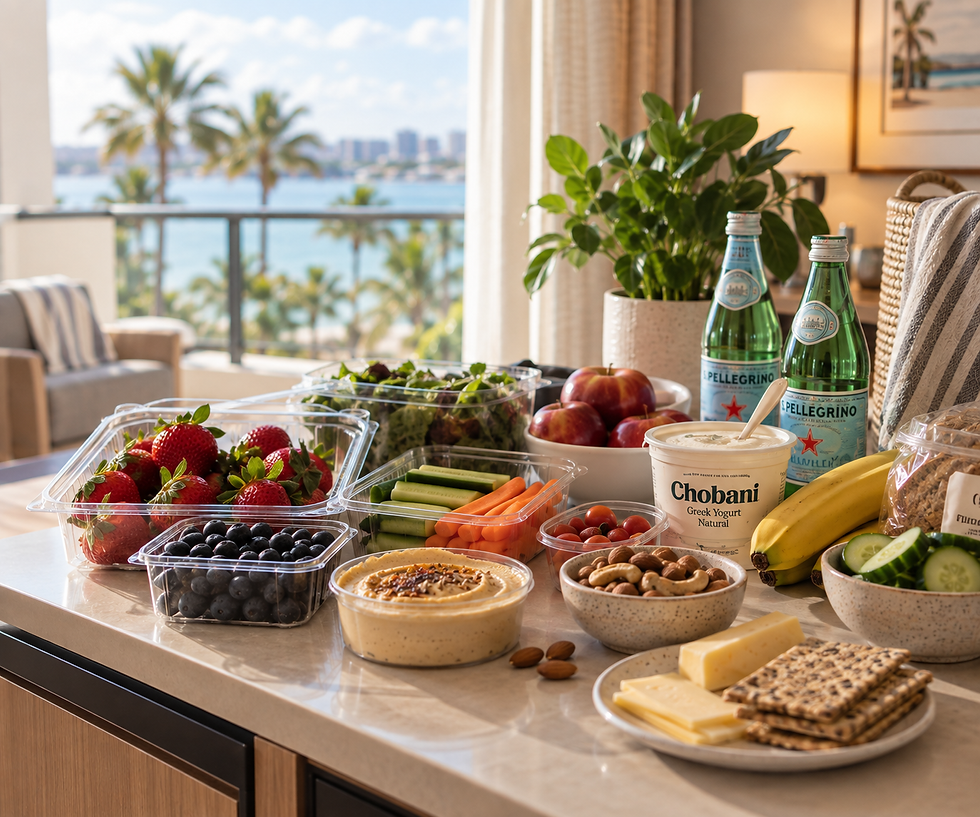
We ordered easy snacks we could keep in the room like yoghurt pouches, berries, baby cucumbers, baby carrots, cheese and cracker packs, coconut water, sparkling water, organic corn chips and hummus.
We didn't have cooking facilities, plates or proper utensils, so there was no point ordering ingredients for beautiful balanced meals we couldn't actually prepare.
I just wanted easy foods that filled the gaps.
Suddenly, when we came back from a theme park starving, chips and pizza weren't our only choices.
We could have some hummus and corn chips. Cheese and crackers. Yoghurt and berries. Cucumbers and carrots.
We could still order the pizza if we wanted it.
But we weren't ordering it simply because everybody was starving and there was nothing else to eat.
That small amount of preparation changed the rest of the week considerably.
Preparation Doesn't Have to Mean Taking Your Whole Kitchen With You
This is probably one of the biggest things I'd change about the way I prepared for this trip.
Most of our previous family holidays have been in self-contained accommodation with kitchen facilities, so I've always had much more control over what we eat. We can stop at a supermarket, stock the fridge and prepare simple meals much as we would at home.
This holiday was completely different.
Staying at a resort without cooking facilities was one thing, but combining that with not having a car really caught me off guard. Suddenly I couldn't simply duck to the supermarket, prepare something easy in the room or fall back on the things I would normally do when the food around us wasn't quite working.
This holiday really put the principles I teach into practice for me. I did exactly what I ask my clients to do — work with the options I had, keep the foundations in place where I could, enjoy the holiday and pay attention to how my body was responding. It wasn't about doing everything perfectly. It was about making it work in real life. And that's really what prompted me to write this article.
Before your next holiday, find out what you'll actually have access to.
Will you have a fridge?
A microwave?
A kitchenette?
Plates and cutlery?
A supermarket within walking distance?
A grocery delivery service?
If you don't have a car, how would you actually get to a supermarket — and how would you prepare what you bought once you got back?
Even grabbing a barbecue chicken and a bag of salad becomes difficult when you have no car to go and buy it, and no plates, cutlery or preparation space when you get back.
What food is available at the hotel or resort?
What are the options likely to be where you're spending your days?
You don't need to plan every mouthful you're going to eat.
In fact, I don't recommend doing that unless you have a medical reason that requires it. Trying to control every meal can very quickly make food restriction the centre of a holiday.
Instead, identify the likely gaps.
For us, breakfast was covered.
Dinner was manageable.
Lunch and afternoon snacks were the weak points.
Had I recognised that before we arrived, I could have organised a small grocery delivery on our first day and made the whole thing easier.
That's the kind of preparation I find useful.
Not controlling the holiday.
Just making sure you have enough foundations underneath it that you're not completely at the mercy of whatever food happens to be in front of you.
Don't Let "Not Perfect" Become "Anything Goes"
There is another trap I see people fall into on holidays.
Once the normal routine is broken, the floodgates open.
You have the dessert because you're on holidays.
Then the cocktail.
Then the chips.
Then breakfast becomes pastries and juice.
None of those individual choices is necessarily a problem.
But eventually you can reach a point where you're no longer really choosing the foods you particularly want.
You're just eating differently because the normal boundaries have disappeared.
That's where I come back to trade-offs.
Some foods are absolutely worth the trade-off.
If I'm sitting by the pool on a family holiday and I want a cocktail, I can have the cocktail and enjoy it.
If we're all getting ice cream together, I don't need to stand there virtuously drinking water because I'm a nutritionist.
But I also don't need every available treat simply because it's there.
There is a big difference between choosing an experience you genuinely want and mindlessly continuing because you've decided healthy eating is temporarily cancelled.
You can enjoy the things that matter to you and still look after your body in between them.
Those two things are not opposites.
"Best Available" Is a Very Useful Standard
Sometimes there simply isn't an ideal option.
That's okay.
Look at what's actually available and ask:
What is the best choice I can make from here?
Maybe you can find some protein or add some fruit or vegetables. Maybe you have something useful in your bag or hotel room. Maybe the burger is genuinely what you want and you'll make the next meal simpler.
And sometimes the best available option right now really is pizza.
Then eat the pizza.
One meal does not define your diet. What matters much more is the overall pattern, the total load, and how your body is coping with it.
You Don't Have to Wait Until You're Unwell to Change Course
This may be the most important part.
A lot of people only respond to their bodies once symptoms become loud enough that they can't ignore them.
But your body will often give you smaller clues first.
The whispers.
The holiday doesn't need to stop.
You may simply need to pull back a little.
Drink more water.
Get some fresh food in.
Prioritise protein and plants again.
Have a simpler dinner.
Get some sleep.
Have a night without alcohol.
Eat something from your grocery stash rather than another restaurant meal.
What you need will depend on your own body and what is contributing to your total load.
The important part is recognising the shift early.
You don't need to wait until your body is shouting if you've learned how to hear it whisper.
And If You Do Go Over Your Threshold?
It happens.
Sometimes the meal, the late night or the cocktail was completely worth it.
Sometimes you didn't realise how close to your threshold you already were.
Sometimes you make a choice knowing perfectly well that your body may complain afterwards.
That's normal life.
The useful question isn't simply: "Did I react?"
It's also: How strongly did I react? How much did it disrupt me? How quickly did I return to my usual baseline?
Learning to notice patterns like these over time can tell you much more than focusing on a single reaction in isolation.
A mild reaction that settles relatively quickly is very different from symptoms that keep building, become increasingly disruptive or take days to settle.
And as you become more familiar with your own body, you become better at recognising which trade-offs are worth it.
That's a far more useful long-term skill than trying to avoid every food that has ever caused you a symptom.
Coming Home Doesn't Require a Detox Either
The same philosophy applies when the holiday is over.
You don't need to compensate for what you ate. You don't need to dramatically cut calories, fast because you "overdid it", or launch into an extreme detox simply because you've spent a week eating differently.
For most people, the first step is simply to return to your usual foundations:
Regular, balanced meals
Protein at each main meal
Plenty of nourishing whole foods and plants
Water
Sleep
Movement
And whatever individual foods and routines you already know help your body feel its best.
Then pay attention to how quickly you return to your usual baseline.
A few mild symptoms that settle fairly quickly are very different from symptoms that are becoming stronger or more disruptive, appearing more regularly, lasting longer, or becoming harder to recover from.
If that's happening, you may have spent a little too much time approaching — or exceeding — your tolerance threshold, and your body may benefit from a more deliberate period of resetting.
That still doesn't mean you need to detox or punish yourself for what you ate on holiday. But it also doesn't mean that a reset is always as simple as going back to healthy eating and waiting for things to settle.
How much support you need depends on how far your body has been pushed, what symptoms have returned or appeared, your individual health conditions and what else may be contributing to your overall load.
For some people, returning to their usual foundations will be enough.
For others, a reset might involve a short period of more targeted dietary restriction, specific nutritional or supplemental support, and then a gradual reintroduction or expansion of foods as their body becomes more stable again.
And the diet itself may look very different from person to person.
The aim isn't to automatically return to the most restrictive diet you've ever followed, or copy somebody else's version of a "reset". It's to work out what your body needs now, in light of your current symptoms and circumstances, and use enough support to help you return to a more stable baseline without unnecessarily restricting yourself.
I go into much more detail in my ebook What to Eat about how to recognise when you've crossed your tolerance threshold, when a reset may be useful, and how to work out what level of reset your body actually needs.
For now, the important thing to remember is this:
Return to your foundations first and watch how your body responds:
If you're easily returning to your baseline, you may not need to do anything more.
If your symptoms are becoming stronger, more disruptive and taking much longer to recover from, that's when a more deliberate and individualised reset may be appropriate.
Our own experience coming home was a good example of just how different that can look from one person to another.
For me, there wasn't much resetting required.
Once I was home I went back to my usual food and foundations and felt reasonably good — although I was left battling some fairly persistent sugar cravings for a few days. After a week of having sweet foods and treats much more readily available than usual, settling back into my normal rhythm was harder than I expected, and I did use some supplement support to help get those cravings back under control.
My daughter was different.
Constipation tends to be one of her signs that things aren't quite right, and by the day before we left I could see that she was really starting to push beyond her tolerance threshold. Her body was already giving us some fairly clear whispers that it was time to pull things back.
On our final morning, that little nagging voice in my head was telling me the same thing: She's had enough. It's time to take back a little more control here.
But it was our last breakfast.
I wanted the kids to have their final holiday hurrah, so against my better judgement I let her enjoy the buffet as she had been doing.
In hindsight, I should have listened to that voice.
Later, on the way to the airport, she desperately needed to open her bowels while we were stuck in the car for around 45 minutes. The abdominal pain became so intense that she vomited. Once she'd been able to go to the toilet she wasn't nauseous or vomiting again, but it still took several days at home for the tummy pains to completely disappear and her bowel habits to return to normal, along with returning to the foods that usually work well for her and some targeted gut support.
For me, the lesson wasn't that she shouldn't have eaten the buffet breakfast.
It was that I'd already recognised that her body wasn't coping particularly well before we sat down to eat it.
I knew her usual pattern. I'd seen the whispers. And my intuition was telling me that we'd reached the point where she needed a little more help to pull back and reset.
That's something I tell my clients all the time: don't automatically dismiss that nagging little voice.
Intuition isn't necessarily something mysterious. Sometimes it's simply your brain recognising familiar patterns and putting pieces together before you've consciously articulated exactly what you've noticed.
When you know your own body — or your child's — and something keeps telling you I think we're pushing this too far now, it's worth paying attention.
So, What Does Healthy Eating on Holiday Actually Look Like?
If I had to reduce the entire approach to four steps, it would be this:
1. Find Protein
Start with protein in whatever form you can, especially at meals you have more control over. This is the anchor of your meal.
2. Add Plants
Add plants to it. Whatever plants you can find - salad, vegetables, fruit, nuts, seeds, etc.
You don't need every meal to contain seven vegetables. Just keep looking for opportunities to bring some fresh food in.
3. Enjoy
Have the foods that are part of the experience.
The cocktail.
The ice cream.
The special restaurant meal.
The amazing breakfast buffet your children will probably still be talking about in five years.
Food isn't only nutrients.
4. Listen and Adjust
Listen to your body.
If the whispers start appearing, don't panic and don't punish yourself.
Just recognise that your total load may be approaching your current tolerance threshold and adjust the balance for a while.
Protein. Plants. Enjoy. Adjust.
The way I ate on our holiday wasn't perfect, and it wasn't how I eat at home.
There were meals I wouldn't normally choose, more chips than I'd usually encounter in a week, treats with my children, cocktails, restaurant food and an ice cream or two.
There were also plenty of occasions where I found some protein, added whatever plants were available, made the best choice I reasonably could — and then got on with enjoying my holiday.
Most importantly, when my body started telling me the balance was tipping too far, I listened.
And to me, that is practising what I preach.
Healthy eating shouldn't require perfect circumstances or feeling like you constantly have to restrict yourself.
If you understand your own body well enough — and feel confident enough in your foundations — you can go out and live your life, knowing when you can comfortably be flexible and what to do when your body starts asking for something different.
Food should be able to fit around your life, rather than your life always having to fit around food.
Taking a trip of your own?
Save the free Eating Well on Holiday guide to your phone so the practical steps are easy to refer back to while you're away.
About the Author
Belinda Babicci is a Clinical Nutritionist and Herbalist specialising in digestive health and food sensitivities. She integrates pathology and genetics-informed insight with structured guidance to identify root drivers — while helping clients understand their body’s signals and confidently manage their own health.


Comments